Wheel Impact Resistance Test

As a wheel brand, ensuring the strength and reliability of your products is critical to maintaining customer trust and meeting market demands. Our rigorous wheel impact tests are designed to simulate real-world conditions, ensuring that the rims you sell can handle whatever cyclists throw their way.

Whether you manufacture road wheels, mountain bike wheels, or all-road products, our impact testing ensures that your products meet or exceed industry standards — from UCI certifications to ASTM specifications. This blog will walk you through our testing procedures, the standards we adhere to, and how our tests can benefit your brand.

Test Standard

We understand that different cycling disciplines have distinct performance requirements. That's why our tests are tailored to each product type to ensure durability under relevant conditions.

Product Type

ASTM Category

Impact Energy

Road Rims

ASTM 1

>60J

All-Road Rims

ASTM 2

>80J

XC / Downcountry / AM

ASTM 3

>110J

Enduro

ASTM4

>140J

DH/e-MTB

ASTM5

>160J


For UCI certification, road wheels must pass an impact energy of 40J using the specific impact head outlined in ISO 4210-3:2023, 4.7.

To align with UCI and ISO regulations, wheels are considered to have failed if they exhibit:
  • Visible cracks or delamination
  • Lateral or radial run-out exceeding 1.0mm

Test Goal

The goal of our impact tests is to simulate real-world riding conditions, predicting how a wheel will perform when it encounters obstacles or technical trails. This helps brands like yours ensure that your products deliver the durability and reliability that professional riders and enthusiasts demand. Road rims are tested without tires to simulate direct rim impacts under high pressure tire setup. Mountain bike wheels are tested with tires mounted, replicating more complex conditions on rugged terrain. We typically set our impact test requirement for new products 10~20% higher than the expected usage, ensuring that every wheel exceeds the anticipated real-world demands.

Test Equipment

The test equipment used in our impact assessments is specifically designed to replicate real-world forces. This allows you to confidently assure your customers that the wheels they purchase are durable and safe, even in the most challenging conditions.
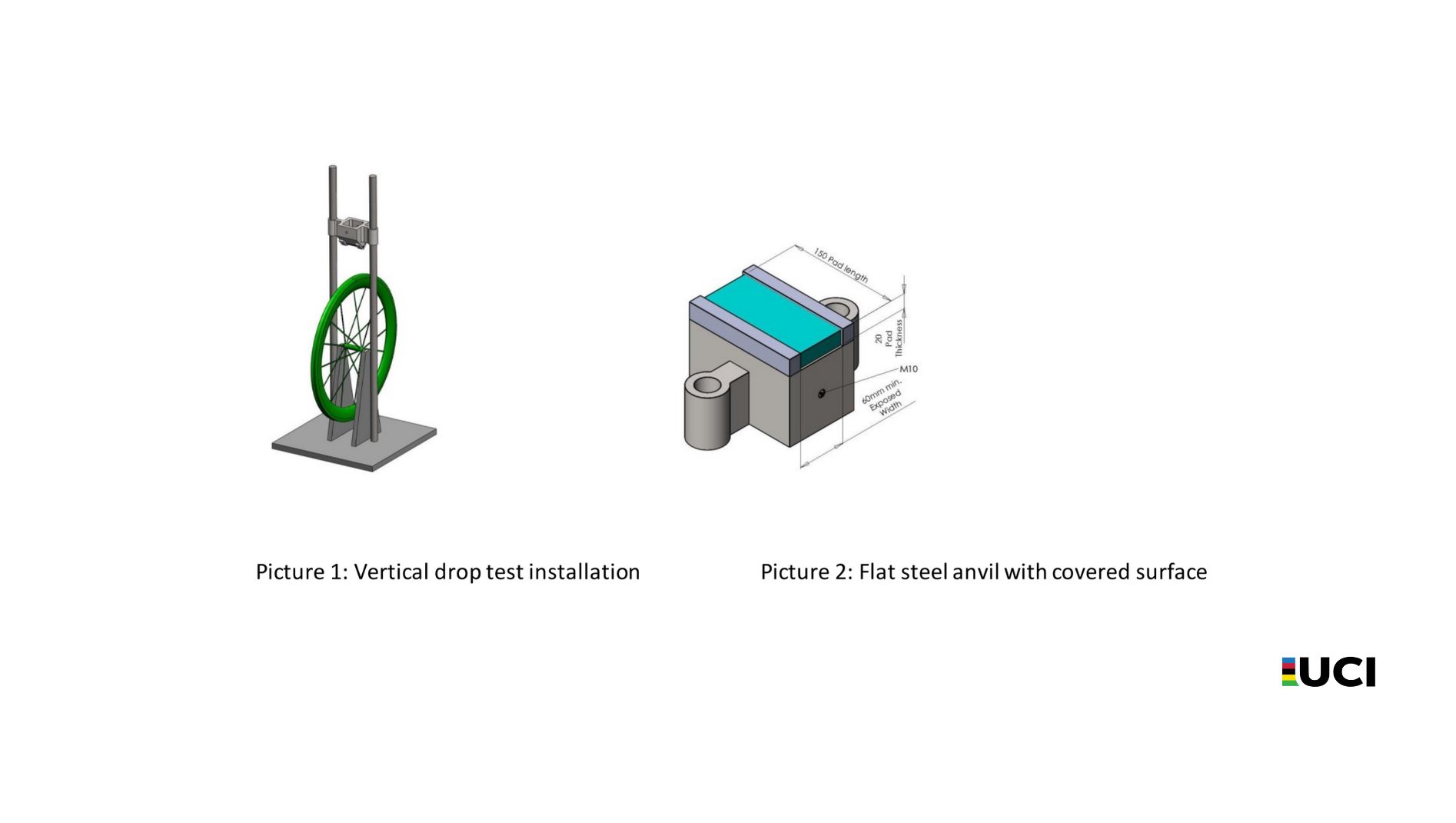
  • Road Bike Rim Test: A flat anvil with a rubber pad (20mm thickness, Shore A=50) is used to distribute the impact force evenly.
  • Mountain Bike Rim Test: A pointed steel striker head simulates the sharper impact of rugged trail riding.

Each striker is calibrated with a specific weight:

  • Flat striker: 24.5kg (for road bike tests)
  • Pointed striker: 22.5kg (for MTB tests)

The fixture is adjusted to ensure the appropriate impact energy is achieved at the point between two spoke holes.

Item

Height Range

Striker Shape

Rubber Pad

Impact Mass

Road

0-2m

Flat

With (Shore A=50)

24.5kg

MTB

0-2m

Pointed

Without

22.5kg

Test Method

Our impact test method is a step-by-step process designed to ensure that every wheel we test meets high standards for quality and performance.

Step 1: The wheel is built to exact trueness and centering specifications. For mountain bike products, a tire is mounted and inflated to ~25psi or lower, as is popular for the specific discipline.

Step 2: We install the appropriate impact head based on the product type or your specific brand requirements. The magnetic attachment is activated to securely hold the striker in place.

Step 3: The wheel is mounted on the test fixture by the axle, with the valve hole positioned at a 90° angle to the impact zone, located between two spoke holes.

Step 4: The impact fixture is raised to the required height, and the striker is released. The wheel is struck, and the technician immediately inspects it for damage.

Step 5: After each strike, the wheel is carefully inspected for any visible cracks, delamination, or loose spokes.

Step 6: The wheel is rotated to the next test spot, and the process is repeated for up to four strikes at the same energy level. Then, the striker height is adjusted to increase the impact energy by 5-10 joules.

Step 7: The wheel is inspected after every impact. Testing continues until the wheel fails (cracks). We record all impact heights and energy levels for your reference.

Sample Test Report

Example profile

Model

Size

Width

Depth

Weight (Stated)

Hub

Spokes

Tire

XC30-22

29er (622-30)

30/35mm

22mm

270g

Novatec D792SB 28H

Sapim CX Ray

Maxxis Ardent 29*2.4"

Test results

Height Increment

Impact Energy

#1

#2

#3

#4

31.7mm

70J

OK

OK

OK

OK

34mm

75J

OK

OK

OK

OK

36.2mm

80J

OK

OK

OK

OK

38.5mm

85J

OK

OK

OK

OK

40.8mm

90J

OK

OK

OK

OK

42.8mm

95J

OK

OK

OK

OK

45.3mm

100J

OK

OK

OK

OK

46.7mm

105J

OK

OK

OK

OK

49.8mm

110J

OK

OK

OK

OK

52.1mm

115J

OK

OK

OK

OK

54.4mm

120J

OK

OK

OK

OK

56.6mm

125J

OK

OK

OK

OK

58.9mm

130J

OK

OK

OK

OK

61.2mm

135J

OK

NG

/

/


At 130J impact, the XC30-22 passed all tests without cracks or delamination. However, at 135J, the rim cracked on the second strike. This data proves that while the XC30-22 is lightweight, it is built for the demands of cross-country racing, delivering outstanding performance on technical trails.

Run-out Measurements:
  • Lateral Run-out: 0.18mm (measured), <0.3mm required
  • Radial Run-out: 0.23mm (measured), <0.3mm required
  • Centering: 0.10mm (measured), <1mm required

With our impact resistance testing, you can confidently assure your customers that your wheels will stand up to the demands of real-world riding. By adhering to industry standards and exceeding them where possible, your brand can offer products that cyclists can rely on.

We work closely with businesses like yours to ensure your products meet regulatory standards and exceed expectations, all while providing traceable, reliable data that supports your product’s durability.

If you're looking to elevate your product testing and showcase your commitment to quality, we can help you make that a reality.
Get Your Custom Quote in 24h
Full Name*
Phone No
Email*
Message*
We use Cookie to improve your online experience. By continuing browsing this website, we assume you agree our use of Cookie.