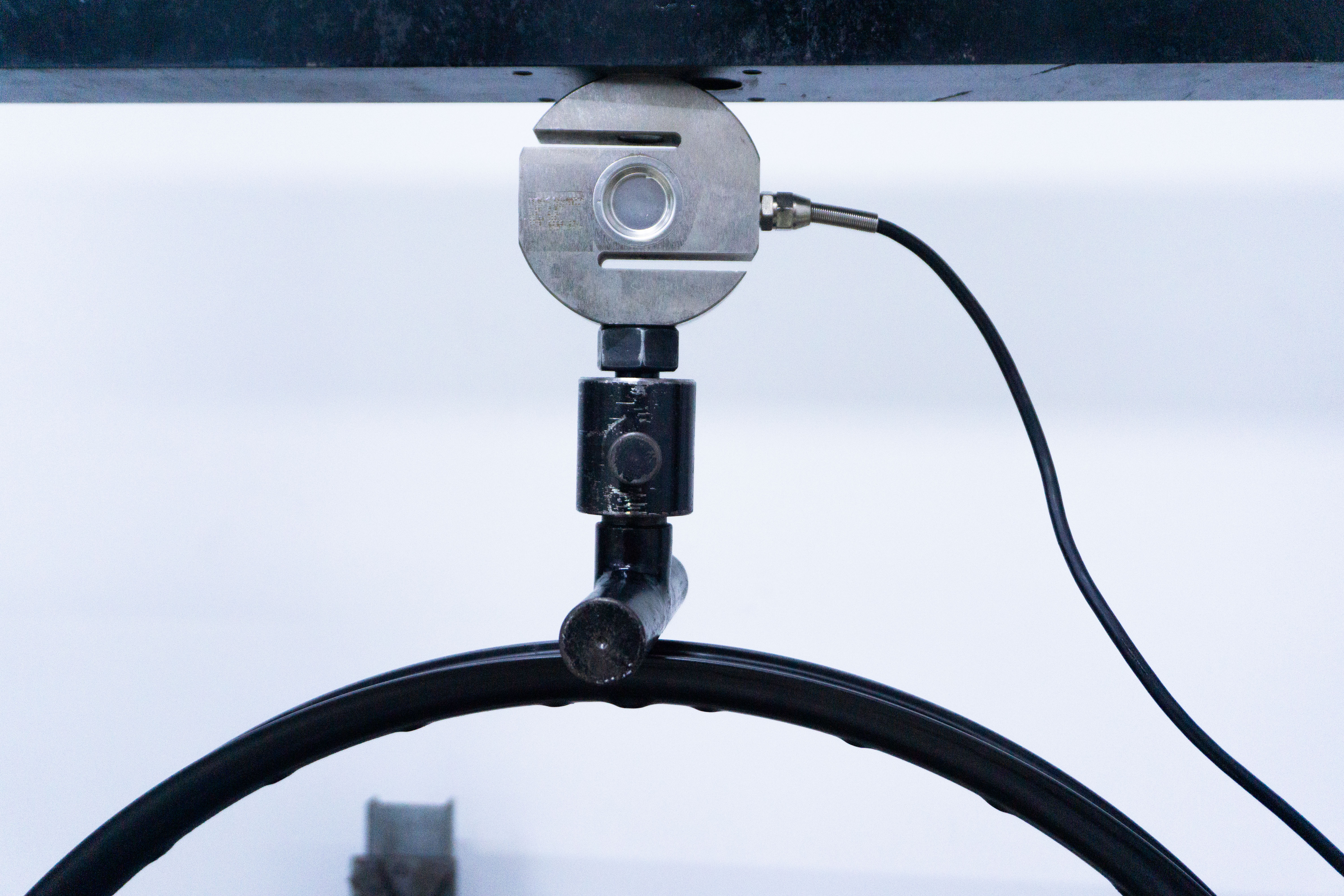
Rim Vertical Stiffness and Deformation Testing

Vertical stiffness plays a crucial role in how a bike rim responds under load, directly impacting both the rider's performance and comfort. In simple terms, vertical stiffness refers to how much a rim deforms vertically when subjected to force. This characteristic is key in determining how energy from the ground and the rider is transferred through the wheel.

Generally, deeper rims tend to offer greater stiffness compared to shallower ones. While a stiffer rim can result in more direct power transfer, it often comes at the expense of comfort, as the ride may feel less compliant. For high-speed, paved-road cycling, greater stiffness is essential to minimize energy loss and optimize efficiency. On the other hand, rougher, less-maintained trails benefit from more compliance in the rim, providing enhanced comfort, better traction, and improved control.

To help predict the rim's performance under different conditions, we conduct rigorous in-house vertical stiffness testing. This data allows us to tailor our rims to meet the specific needs of cyclists, whether they're focused on speed or comfort.


Test Standard

The vertical stiffness of our rims is customized based on our client’s requirements, with a focus on the intended application and target rider. Stiffness is quantified in N/mm (Newtons per millimeter), which measures the force required to cause a certain amount of rim deformation. For our tests, we ensure that the rim does not undergo plastic deformation or develop any cracks during the testing process.

For consistency and accuracy, we conduct the test at two specific points on the rim:
1. The valve hole
2. A point 90° from the valve hole, between two spoke holes

Test Goal

The primary objective of the vertical stiffness test is to simulate how the rim will perform when it’s part of a complete wheel. By testing the rim independently, we eliminate the influence of other wheel components (like spokes and hubs) on the stiffness data, ensuring the results are as precise and relevant as possible.

Test Equipment

To measure vertical stiffness, we use a Universal Testing Machine (UTM). This sophisticated equipment features a rigid base and clamping system that securely holds the rim in place. A compression fixture above the rim applies a gradually increasing force (up to 50kgf), while a sensor records the resulting deformation. The data is then synced to a computer for detailed analysis.

Moving Speed

Test Spots

Max Applied Force

Test Side

0.4m/s

#1 Valve hole side

#2 Perpendicular to the valve hole (between two spoke holes)

50kgf

Double side

Test Method

Step 1: Mark two points on the rim, one at the valve hole and the other 90° from it (between two spoke holes).
Step 2: Secure the rim onto the testing apparatus to ensure it remains in place throughout the process.
Step 3: The compression fixture is lowered to make contact with the rim at the first test point. The machine then applies downward force at a controlled speed, gradually increasing the load up to the preset limit of 50kgf.
Step 4: As the load is applied, the fixture records any deformation of the rim, and this data is sent to the computer for further analysis.
Step 5: After completing the first test, the fixture is lifted, and the rim is rotated 90° to the second test spot. The process is then repeated.
Step 6: Once both test points have been measured, the data is exported for analysis, helping us evaluate the rim's overall stiffness.

Sample Test Report

Example Profile

Model

Size

Width

Depth

Weight (Stated)

Measured Weight

G30-45

700C (622-30)

28.5/34.1mm

45mm

410g

416g

Test Results

Test Spot

Force Applied

Deformation

Lateral Stiffness

#1 (Valve Hole Side)

50kgf

1.71mm

286.55N/mm

#2 (Perpendicular to Valve)

50kgf

1.69mm

289.94N/mm


In this example, the rim exhibits vertical stiffness values of 286.55 N/mm at the valve hole side and 289.94 N/mm at the perpendicular test point. These results indicate that the rim is highly resistant to deformation under load, offering significant stiffness—ideal for high-performance racing applications.
Get Your Custom Quote in 24h
Full Name*
Phone No
Email*
Message*
We use Cookie to improve your online experience. By continuing browsing this website, we assume you agree our use of Cookie.