Rim Lateral Stiffness and Deformation Testing

Lateral stiffness is a key measure of a rim’s ability to resist sideways deformation when subjected to external forces. This is especially important for high-performance activities like sprinting and cornering, where the rim needs to maintain its shape and structural integrity under significant loads. Typically, rims with wider profiles offer greater lateral stiffness, which translates to improved responsiveness and stability in aggressive riding conditions.


Test Standard

The lateral stiffness requirement is tailored to each client’s needs, based on the intended use and target customer. The stiffness is expressed in N/mm (Newton per millimeter), indicating the amount of force needed to cause a certain degree of rim deformation. During testing, there must be no plastic deformation or cracks in the rim.

For consistency, we test two specific points on the rim:
#1 The valve hole
#2 The point 90° from the valve hole (between two spoke holes)

Test Goal

The goal of this test is to accurately predict how the rim will perform when built into a complete wheel. By testing the rim alone, we eliminate variables from other components that could affect stiffness, ensuring the data is as precise and relevant as possible.

Test Equipment

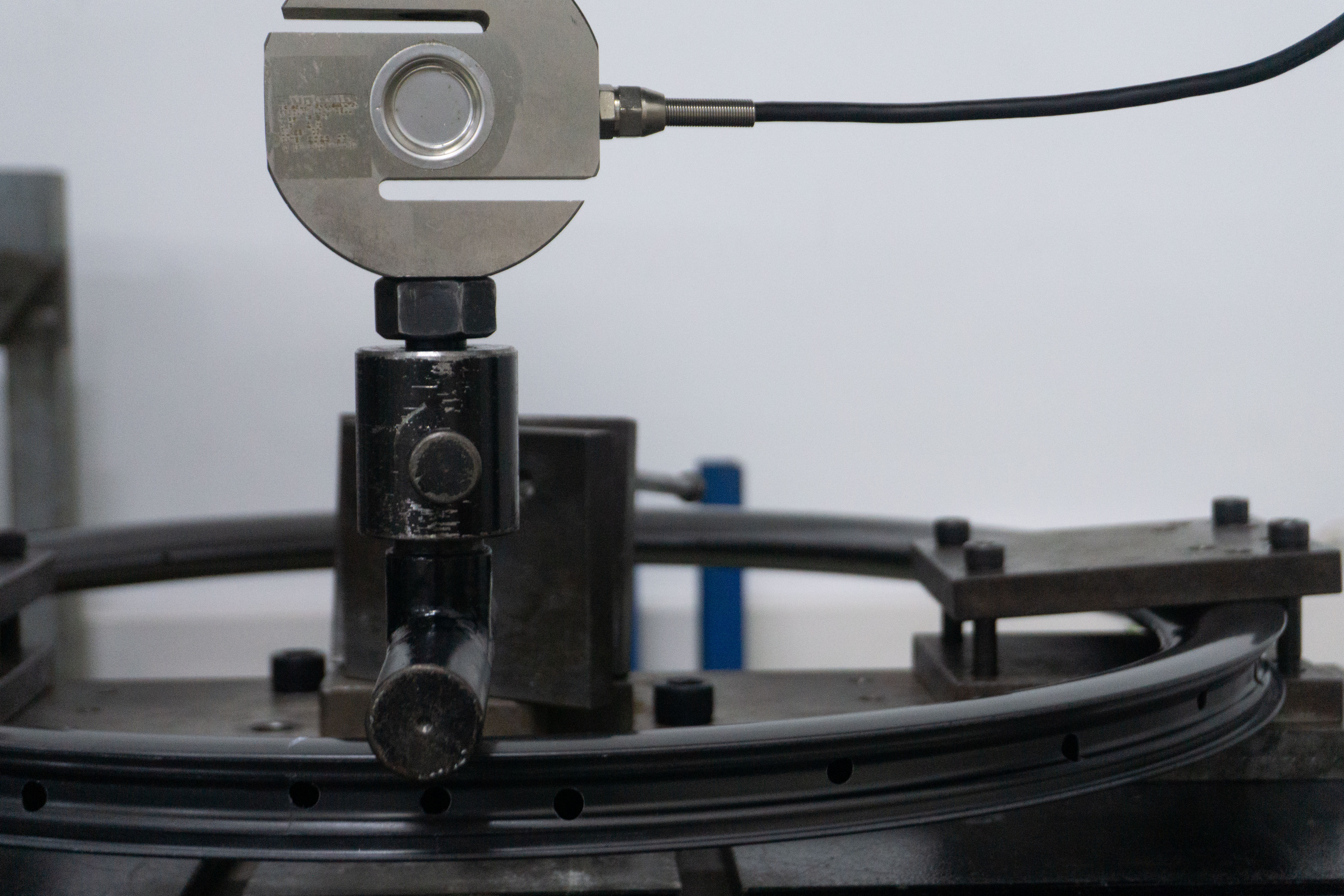
We use a Universal Testing Machine (UTM) for lateral stiffness testing. The machine features a rigid base and clamping system to securely hold the rim. Above the rim is a compression fixture that applies gradually increasing force (up to 30kgf). As the load increases, the sensor records any rim deformation, and this data is synced to a computer for analysis.
Moving Speed Test Spots Max Applied Force Test Side
0.4m/s #1 Valve hole side
#2 Perpendicular to the valve hole (between two spoke holes)
30kgf Single Side

Test Method

Step 1: Mark two test spots on the rim — one at the valve hole and the other 90° from the valve (between two spoke holes).
Step 2: Securely clamp the rim onto the testing rig.
Step 3: Using a remote control, lower the compression cylinder until it touches the edge of the rim at the first test spot (#1).
Step 4: The compression fixture applies downward force at a controlled speed, gradually increasing the load up to a preset limit of 30kgf.
Step 5: After completing the first test, lift the compression fixture and rotate the rim to the second test spot (#2) and repeat the process.
Step 6: After the test is complete, export the data charts from the computer for analysis.

Sample Test Report

Example Profile

Model

Size

Width

Depth

Weight (Stated)

Measured Weight

G28-45

700C (622-28)

28.5/34.1mm

45mm

400g

395g

Test Results

Test Spot

Force Applied

Deformation

Lateral Stiffness

#1 (Valve Hole Side)

30kgf

5.61mm

52.41N/mm

#2 (Perpendicular to Valve)

30kgf

5.85mm

48.55N/mm

In this example, the rim shows a lateral stiffness of 52.41 N/mm at the valve hole side, and 48.55 N/mm at the perpendicular test point, indicating a high level of stiffness and resistance to deformation under load.

Get Your Custom Quote in 24h
Full Name*
Phone No
Email*
Message*
We use Cookie to improve your online experience. By continuing browsing this website, we assume you agree our use of Cookie.