Carbon Prepreg Inspection: Resin Content Percent (RC%)

At NTP Composites, we use carbon prepregs as raw materials in the production of high-quality bike rims and framesets. "Prepreg" is the industry term for reinforcing carbon fiber fabric that has been pre-impregnated with a resin system. Typically, the resin system is based on epoxy and includes a curing agent. When heat and pressure are applied, these thermoset prepregs are cured into a solid state, forming the base for our high-performance products. 

Test standard

A prepreg is a composite of fabric and resin, and the resin content is referred to as the Resin Content Percent (RC%). For the carbon prepregs we use, the typical RC% ranges from 30% to 37%. However, the actual RC% may vary between manufacturers. Our Incoming Quality Control (IQC) technicians inspect the resin content of each batch, referring to the manufacturer’s stated RC% as indicated on the product packaging.

Test Goal

The goal of the RC% inspection is to ensure that the raw materials used in production meet our strict quality standards. This step is crucial to avoid costly errors downstream. The resin content in prepregs directly impacts both product strength and the efficiency of the manufacturing process. Specifically, it affects curing time, material bonding, and overall durability.

Test Equipment

To accurately measure RC%, the following equipment is used:
  • Lab beakers
  • Stir sticks
  • Methyl ethyl ketone (MEK) solvent
  • Analytical scale for precise weight measurement

Test Method

The inspection process involves the following steps:

Step 1: Specimen Preparation
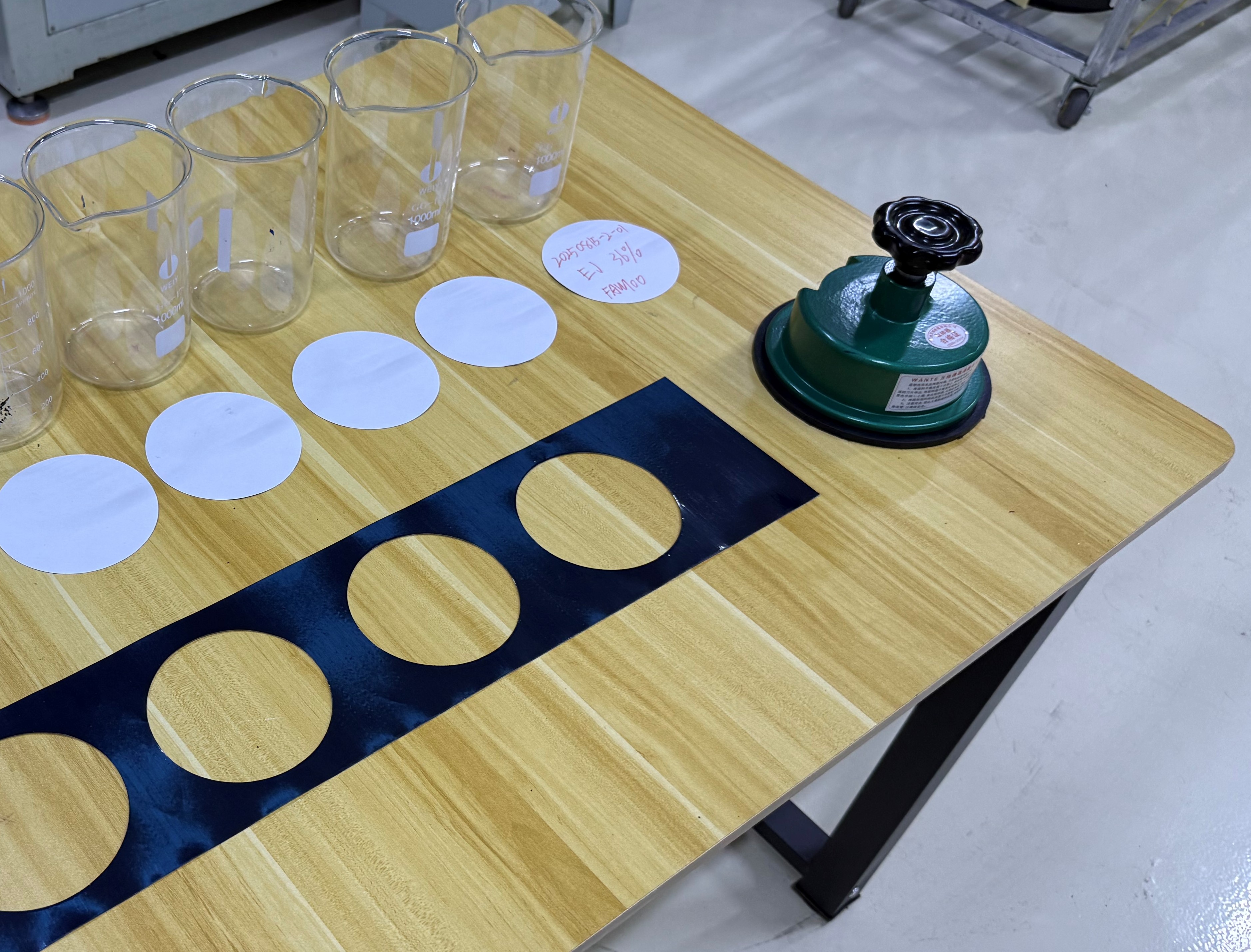
We begin by de-frosting one roll of prepreg at room temperature for 24 hours. From this roll, a sample of 15 x 100 cm is carefully cut. Five round specimens (10 cm in diameter) are then taken, ensuring they are evenly spaced across the sample laminate. Each specimen is labeled from #1 to #5.

Step 2: Initial Weight Measurement
After removing the two backing cloths from each specimen, we weigh them and record the initial weights.

Step 3: Resin Removal
The specimens are immersed in MEK solvent within lab beakers for 30 minutes. Afterward, the solvent is drained, and the specimens are washed with water. This process is repeated three times to ensure complete resin removal.

Step 4: Fiber Drying
The remaining fibers are then dried in an oven at 100°C for at least three hours to fully remove any remaining moisture.

Step 5: Final Weight Measurement and RC% Calculation
Once the fibers are completely dry, they are weighed again. The loss of weight (due to the removal of resin) is calculated, and the resin content percentage (RC%) is determined using the following formula:

RC% = (Weight Loss / Original Weight) x 100

The RC% is calculated for each specimen, and the results are recorded.

Sample Test Report

Sample Info

Manufacturer

Width

Stated RC%

FAW (g/m²)

Weave

Batch No.

JS

1000mm

36 (±2%)

75

UD

Y2251107028

Test Results

Specimen No.

#1

#2

#3

#4

#5

Prepreg Weight (g)

1.57 1.58 1.57 1.58 1.57

Dry fiber weight (g)

1.00 1.00 0.98 0.99 1.01

Loss of weight (g)

0.57 0.58 0.59 0.59 0.56

Actual RC%

36.31% 36.71% 37.58% 37.34% 35.67%

The measured RC% of all five specimens is within the manufacturer’s stated RC% range. Test passed.
Get Your Custom Quote in 24h
Full Name*
Phone No
Email*
Message*
We use Cookie to improve your online experience. By continuing browsing this website, we assume you agree our use of Cookie.