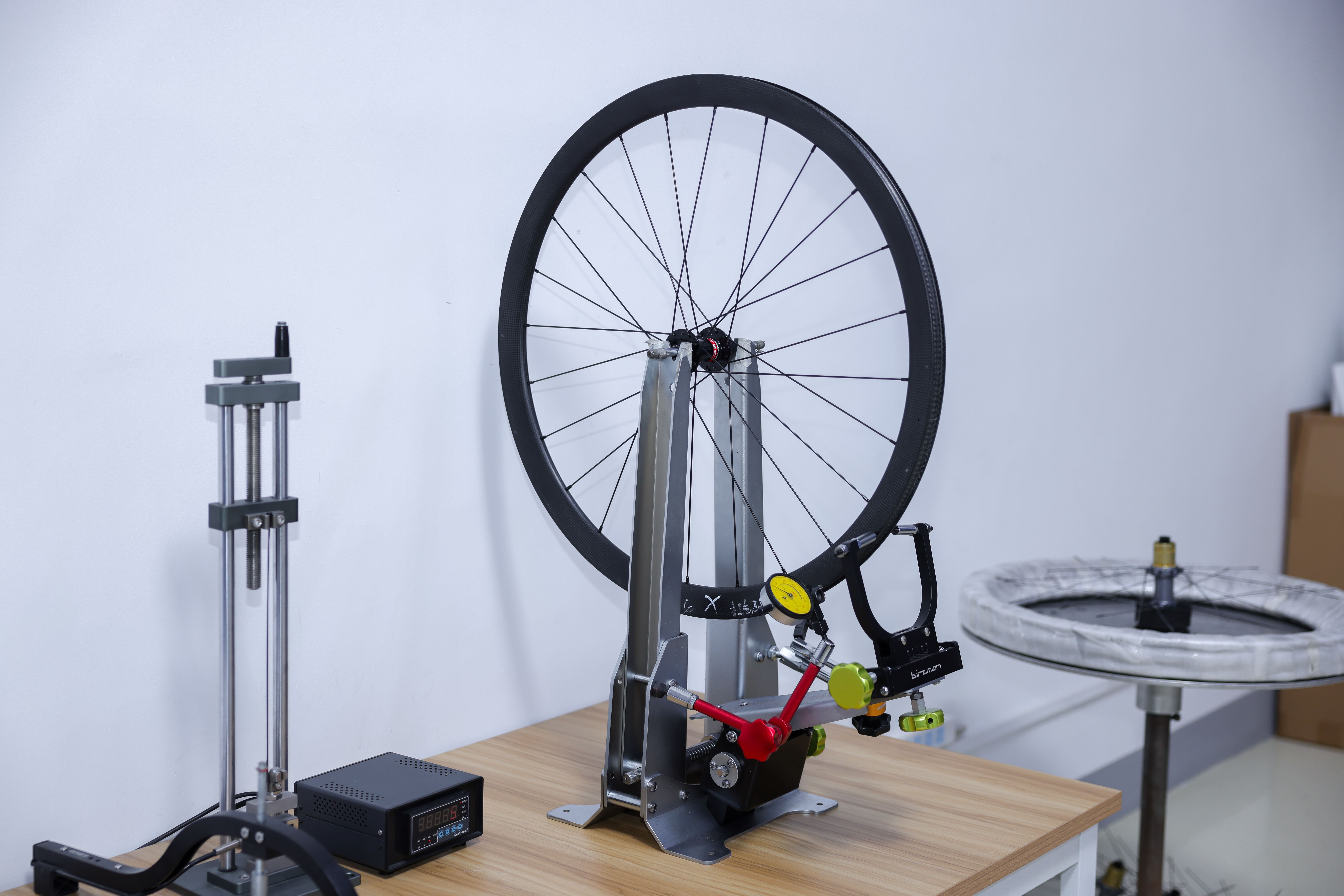
Applied Wheel Building Test: Ensuring Systemic Reliability

A high-performance rim doesn’t just stand alone—it’s part of a finely tuned system where every component must work in harmony. At our factory, we believe that a premium wheel building experience begins with ensuring that every rim is compatible with other wheel parts. With over five years of hands-on expertise, our in-house wheel builders meticulously lace and tension each wheel while collaborating closely with product engineers and managers to identify and resolve any potential issues.


Test Standard: Objective and Subjective Assessments

Our applied wheel building test is based on two key elements: measurable performance data and a subjective assessment based on the professional judgment of our experienced wheel builders.

1. Quantifiable Test Standards
  • Centering: within 1mm
  • Radial & lateral run-outs: within 0.3mm
  • Spoke tension deviation: within 10kgf (same-side)

2. Subjective Assessment Checklist 
  • Nipple hole angle;
  • Spoke alignment;
  • Bulges around nipple holes;
  • Nipple hole thickness;
  • Abnormal noises or crack formations;
  • Spoke access hole angle;
  • Ease of trueness adjustments;
  • Ease of spoke tension adjustments

Test Equipment & Method

Our wheel builders use industry-leading tools to ensure precision in each wheel build. These include:
  • Park Tool Wheel Building Stand
  • Sapim Spoke Tension Meter
  • Dishing Tool

For every wheelset, we build both the front and rear wheels to ensure a comprehensive test of compatibility and overall wheel integrity.

Step 1: Wheel Lacing: The builder begins by lacing the wheel with the designated hub, spokes, and nipples in the desired lacing pattern.
Step 2: Tensioning: Spoke tensions are drawn evenly across the wheel. Once the wheel is taut, the spoke tensions are measured, and any deviation from the standard (120-130kgf on the rear drive side) is noted.
Step 3:  Truing: The wheel is trued by adjusting lateral and radial run-out, as well as the dishing. This process brings spoke tensions into alignment with the specified standards.
Step 4: Stress-Relieving: Once trued, the wheel undergoes a stress-relieving process to ensure that the nipples and spoke heads are securely seated. If any tension or trueness shifts during this phase, the wheel is re-trued and re-stress-relieved.
Step 5: Final Inspection: A detailed inspection is conducted, focusing on nipple hole areas for any deformation or cracks, as well as the alignment of spokes from the hub flange to the nipple hole. The protrusion length of external nipples is also checked.

Sample Test Report

Example Profile

Model

Size

Position

Width

Depth

Weight (Stated)

Measured Weight

G28-45

700C (622-28)

Rear

28.5/34.1mm

45mm

400g

408g

Test Results

Measurements

Hub

DT SWISS 350

Nipple

Sapim Polyax double square alloy

Spoke

Sapim CX Ray 14G

Lacing Pattern

2-cross

Lateral Runout

0.13mm

Radial Runout

0.25mm

Centering

0.8mm

Hole Count

24H

Left side spoke tension

Right side spoke tension

#1

65kgf

#1

125kgf

#2

62kgf

#2

123kgf

#3

70kgf

#3

127kgf

#4

68kgf

#4

128kgf

#5

69kgf

#5

129kgf

#6

63kgf

#6

131kgf

#7

62kgf

#7

125kgf

#8

66kgf

#8

130kgf

#9

64kgf

#9

133kgf

#10

69kgf

#10

127kgf

#11

63kgf

#11

128kgf

#12

68kgf

#12

126kgf

Tension deviation

8kgf

Tension deviation

10kgf

The spoke tension deviations are within the acceptable range of 10kgf, and the overall spoke tensions are well balanced.

Wheel Building Ease Checklist

No.

Inspection

Result

1

Spoke alignment (nipple end and hub flange end)

OK

NG

2

Nipple hole angle compatibility with the sample hub

OK

NG

3

Evenness of the protruded length of nipples

OK

NG

4

No deformation (bulge or dent) or cracks around the holes

OK

NG

5

No abnormal noise during wheel tensioning and truing

OK

NG

6

Ease of using a spoke lacing tool through spoke access holes on the rim bed

OK

NG

7

Ease of lateral truing

OK

NG

8

Ease of radial truing

OK

NG


By combining objective measurements with subjective evaluations from our seasoned wheel builders, we can identify and resolve potential issues early in the process. This ensures that every rim meets the highest standards of quality and performance, while also guaranteeing smooth and reliable mass production. The applied wheel building test is not just about meeting specs—it’s about ensuring the reliability, durability, and ease of use for every wheel we produce.
Get Your Custom Quote in 24h
Full Name*
Phone No
Email*
Message*
We use Cookie to improve your online experience. By continuing browsing this website, we assume you agree our use of Cookie.