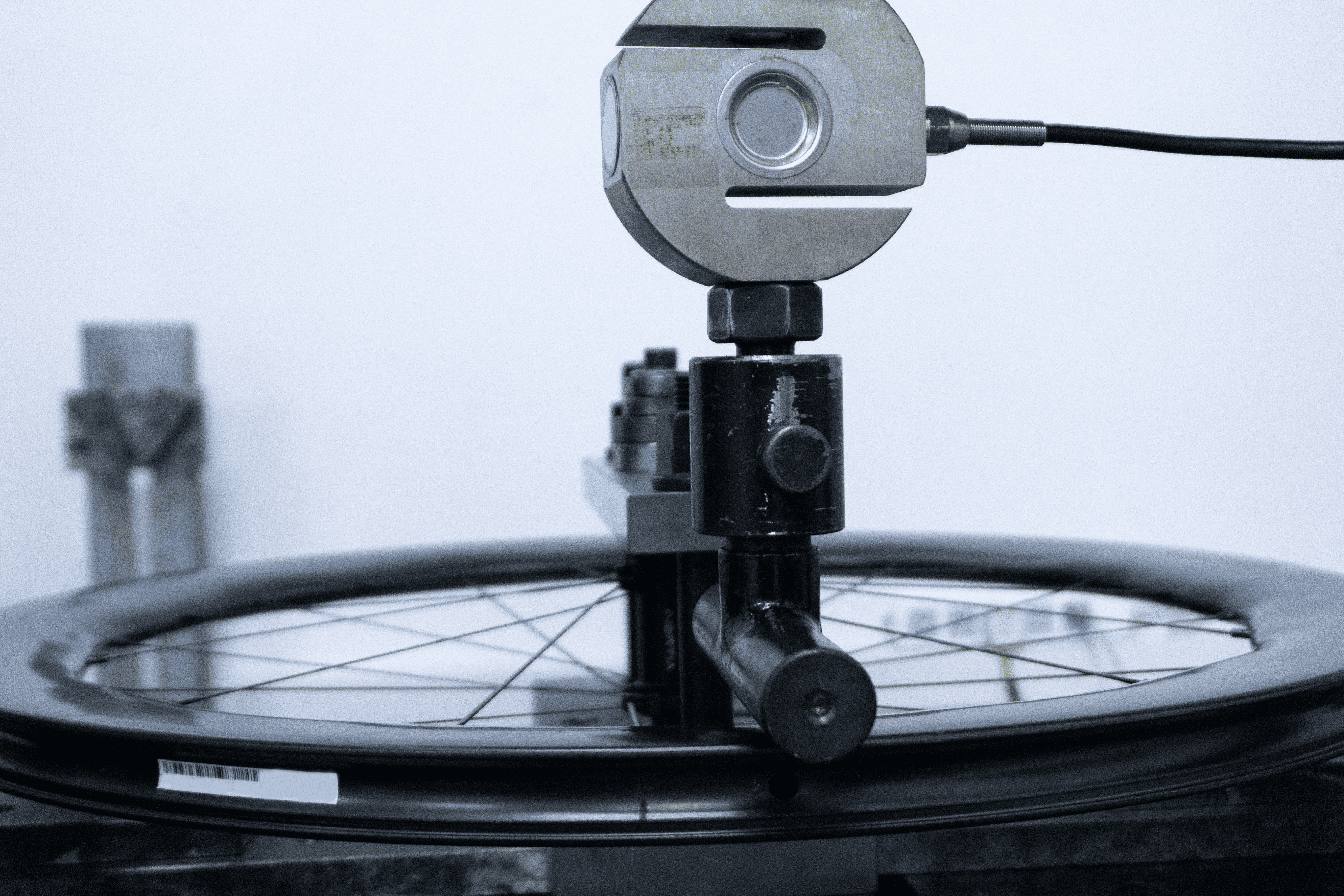
Wheel Lateral Stiffness and Deformation Testing

Lateral stiffness is a crucial measure of a wheel's ability to resist sideways deformation when subjected to external forces. This property is particularly important in high-performance cycling activities like sprinting and cornering, where the rim must maintain its shape and structural integrity under sudden, high loads.


Test Standard

At NTP, lateral stiffness testing is not required for every product. Instead, we tailor the stiffness requirements to each client's specific needs, based on the intended use and target audience of the wheel. Some clients also request comparative tests to evaluate new wheel designs and configurations. It’s essential during testing that no plastic deformation or damage occurs to the rim or wheel components.

Test Goal

The primary goal of lateral stiffness testing is to predict how the completed wheel will perform with all its designated components assembled. This helps our clients verify their new wheel designs, including lacing configurations, spoke types, and component choices, ensuring the final product delivers the desired performance.    

Test Equipment

We use a Universal Testing Machine (UTM) for lateral stiffness testing, which also serves for our rim stiffness tests. The UTM is equipped with a rigid base and a clamping system that securely holds the hub through the axle. Above the rim, a compression fixture applies gradually increasing force. As the load increases, sensors monitor rim deformation, and this data is fed into a computer for analysis.

Moving Speed

Test Spots

Applied Forces

Test Side

0.4m/s

Four key points around the rim (3, 6, 9, and 12 o'clock positions), with maximum load applied at the valve side (6 o’clock position).

5kgf, 10kgf, 15kgf, and 20kgf, based on client specifications.

Single Rim Side

Test Method

Step 1: Assemble the wheel according to the client’s specifications, ensuring it is properly tensioned, trued, and de-stressed.

Step 2: Label the four test positions on the rim (3, 6, 9, and 12 o'clock).

Step 3: Clamp the wheel onto the testing rig, ensuring the test spot is positioned below the compression fixture.

Step 4: Using a remote control, lower the compression fixture until it contacts the rim edge at the designated test spot.

Step 5: Gradually apply force at a controlled speed, increasing it up to a preset limit.

Step 6: After completing the test at the first spot, lift the compression fixture, rotate the rim to the next test spot, and repeat the process with progressively lower forces (15kgf, 10kgf, etc.). Continue this for all four test spots.

Step 7: Once all tests are complete, export the deformation data from the computer for analysis.

Sample Test Report

Example Profile

Model

Size

Width

Depth

Weight (Stated)

Measured Weight

R23-60

700C (622-23)

23/28.5mm

60mm

420g

425g

Hub

Position

Hole

Spoke

Lacing

Spoke Head

Client’s branded hub

Rear

24H

Pillar PSR X-TRA 1420

2X (spokes touching)

Straightpull

Test Results

Test Spot

Force Applied

Deformation

Lateral Stiffness

#1: 6 o’clock (valve side)

20kgf

4.36mm

44.95N/mm

#2: 9 o’clock 

15kgf

3.13mm

46.94N/mm

#3: 12 o’clock 

10kgf

1.78mm

55.06N/mm

#4: 3 o’clock

5kgf

0.48mm

102.08N/mm


In this example, the wheel shows premium lateral stiffness across the wheel under high and low forces. The results demonstrate a high level of resistance to deformation, indicating the wheel's ability to maintain its shape and performance under load.
Get Your Custom Quote in 24h
Full Name*
Phone No
Email*
Message*
We use Cookie to improve your online experience. By continuing browsing this website, we assume you agree our use of Cookie.